
Application Case of “High Voltage Sample Low Voltage Compensation ” Reactive Power Compensation in Photovoltaic Power Generation Sites
1. Project Background
With the formulation of the “dual carbon” goal by the country, it has brought significant development opportunities and broad prospects to China’s photovoltaic power generation industry. The State Council issued the notice on the release of the action plan for carbon peak in 2030, clearly stating that by 2030, the total installed capacity of wind and solar power generation should reach over 1.2 billion kilowatts.
As distributed photovoltaic power generation projects have been widely popularized in industrial and commercial users, parks, and residential scenarios, the green energy benefits brought by photovoltaic grid-connected power generation have become increasingly prominent. However, at the same time, the problem of low power factor caused by the connection of photovoltaic systems to the power grid has also become a common pain point faced by many users. The output characteristics of photovoltaic power generation itself, as well as the imbalance of reactive load on the power grid side, can easily lead to the failure to meet the power factor standards of the overall power consumption circuit, failing to meet the assessment standards of the power department, and thus resulting in additional power factor fines. This not only increases the electricity cost for users but also weakens the economic benefits of photovoltaic power generation projects, and even affects the stable and efficient operation of the power grid.
2. Industry Status
According to the provisions of the “Power Factor Adjustment Electricity Fee Method”, for general industrial users, the average power factor of the users must reach above 0.9; otherwise, they will be subject to electricity penalties. Currently, factories generally use traditional capacitor switching for reactive power compensation. When there is no photovoltaic installation on site, due to the huge consumption of active power in the power grid, although the capacitor compensation has certain disadvantages, it will result in some remaining reactive power that cannot be fully compensated. However, compared with the consumed active power in the power grid, this is insignificant and still ensures that the power factor reaches above 0.9.
However, when photovoltaic is installed on site, photovoltaic power generation provides a large amount of active power, causing the active power consumed by the load from the power grid to sharply decrease. At this time, the remaining reactive power compensated by the capacitor compared with the consumed active power in the power grid becomes very important; at the same time, the transformer itself and the transmission lines will also generate certain reactive power, causing the remaining reactive power on the high-voltage side to further increase, resulting in a sharp decline in the power factor on site and generating a large amount of electricity penalties, causing significant losses to the users and photovoltaic manufacturers.
3. “High Sampling and Low Compensation” Solution
Currently, power companies typically conduct power metering at the high-voltage side. When calculating reactive power, it not only includes the reactive power generated by the low-voltage side load, but also the reactive power generated by transformers and transmission lines. The conventional low-voltage-side treatment can only compensate for the reactive power generated by the load, but cannot effectively compensate for the reactive power generated by transformers and transmission lines.
For photovoltaic power generation sites, we cannot ignore the reactive power generated by transformers and transmission lines. Therefore, we have designed a product application solution called “High Sampling and Low Compensation”, which samples at the incoming line of the high-voltage side and compensates at the low-voltage side, thus achieving the purpose of simultaneously compensating reactive power on the high-voltage side and the low-voltage side.
Compared with traditional high-voltage reactive power compensation devices, the “High Sampling and Low Compensation” solution not only has a significant price reduction, but also has simple construction and installation and convenient maintenance.
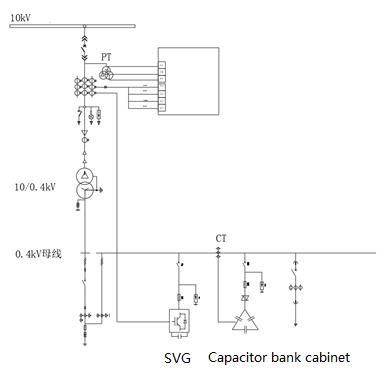
The “high voltage sample low voltage compensate” compensation mode can be used in conjunction with the existing compensation devices on site. The compensation capacity is mainly configured based on the remaining reactive power on the high-voltage side. The installation method of the device is flexible, including wall-mounted installation, cabinet installation, and outdoor installation in containers, etc., which can be applicable to various on-site situations. During equipment installation, it is necessary to ensure that the compensation current of “high extraction and low supplementation” cannot be sampled by the original compensation device, so as to ensure the normal operation of the original compensation device. The “high voltage sample low voltage compensation” device compensates for the remaining reactive power at a lower cost to achieve high-precision reactive power compensation.
4. Application Results
The reactive power has significantly decreased.
Based on the measurement data from the high-voltage side, we can observe that before the treatment, the reactive power at the high-voltage side fluctuated around 20 kvar at night and reached over 60 kvar during the day. After the treatment, the reactive power has significantly decreased, and it remains stable at around 0 kvar for most of the time.
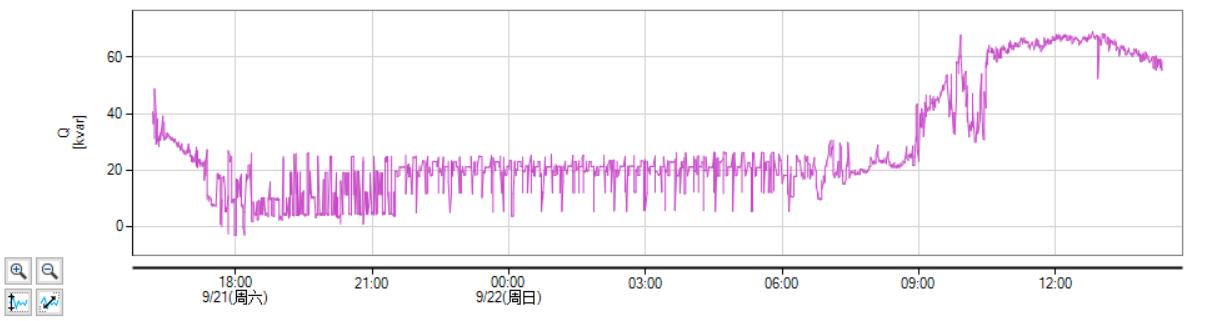
Before installation SVG
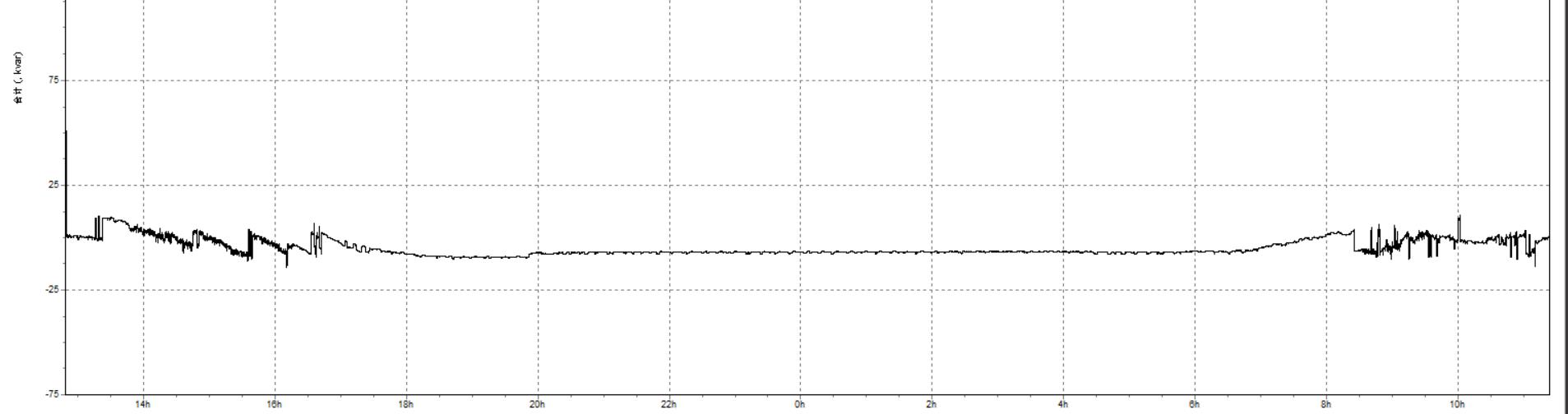
After installation SVG
Power factor significantly improved
After the treatment, when checking the user’s electricity bill, the on-site power factor increased from 0.77 to 0.94, achieving a significant improvement. Not only was there no penalty, but the user also received an electricity bill reward.
5. Case Summary and Promotion Value
The high voltage sample low voltage compensation solution, leveraging its precise adaptation and efficient regulation advantages, has become the core solution for addressing the issue of low power factor after the integration of photovoltaic power into the grid. This solution aligns with the operational characteristics of the grid after photovoltaic integration, adopts differentiated collection and compensation strategies, accurately identifies the system’s reactive power gaps and load fluctuation patterns, and conducts targeted dynamic regulation of reactive power, quickly compensating for reactive power losses, and efficiently and stably enhancing the overall power factor, ensuring that the user’s power factor consistently meets the requirements of the power department, fundamentally eliminating power penalties due to non-compliant power factor, effectively reducing the user’s additional operating costs, and guaranteeing the maximum benefits of the photovoltaic power generation project.
This solution has strong adaptability and synergy with the photovoltaic power generation system, requiring no large-scale modification of the original photovoltaic equipment, and can achieve seamless connection and synchronous operation. It also has multiple advantages such as convenient installation, stable operation, simple maintenance, controllable investment costs, and significant energy-saving benefits. On one hand, it can optimize the power quality of the grid, reduce reactive power losses in lines, improve grid transmission efficiency, and ensure the stable transmission of photovoltaic power; on the other hand, it helps users avoid economic losses, revitalize the profit space of the photovoltaic project, balance the user’s economic benefits and the stability of grid operation, and truly achieve a win-win situation for green power generation and compliant power consumption.
Post time: Jun-29-2026